
Almost half of all UK adults, 46% according to Finder’s January 2026 survey of 2,000 Brits, now earn money from a side hustle. That is not a trend. That is a structural shift in how people in this country think about income.
The average UK side hustler earns £872 a month, roughly 44% of a full-time salary, according to the same research. In London, that figure climbs to £1,331.
And with Making Tax Digital now live for higher earners and HMRC receiving automatic data from platforms including Vinted, Etsy, eBay and Deliveroo, the rules have changed significantly in 2026.
This guide covers everything: what counts as a side hustle under UK law, 30 realistic ideas with real earnings data, the £1,000 trading allowance fully explained, what HMRC now knows about your income, the new MTD rules, how different professions need to approach this differently, and the honest path from first pound to full-time income.
Bookmark it. You will return to different sections at different stages of your hustle.
What is a Side Hustle and How Does HMRC Define It?
A side hustle is any income-generating activity you pursue alongside your primary source of income, whether that is a job, a pension, student finance, or benefits.
The term covers a broad spectrum like dog walking on weekends, selling handmade candles on Etsy, driving for Amazon Flex on Tuesday evenings, freelance writing at midnight, and everything in between.
But HMRC does not care about the label. HMRC cares about one question: are you trading?
The distinction matters more than most people realise.
Selling Your Own Unwanted Possessions: Not a Side Hustle
If you sell old clothes from your wardrobe on Vinted, shift unwanted furniture on Facebook Marketplace, or offload last year’s gadgets on eBay, you are not trading. HMRC generally does not treat this as taxable income.
There is no registration required, no allowance to worry about, and no tax return to file (as long as you stay under the Capital Gains Tax annual exempt amount, which is £3,000 for 2025/26, for any item sold above what you paid for it).
Buying or Creating Things to Sell for Profit: That is Trading
The moment you purchase items specifically to resell them, make products to sell, or offer services to customers, you are trading. It does not matter how small-scale, casual, or informal it feels. If the activity is ongoing and designed to generate profit, it counts.
HMRC applies what it calls the “badges of trade” test. The main questions it asks:
- Did you buy or make this with the intention of selling at a profit?
- Do you do this repeatedly and with some organisation?
- Is the volume and frequency consistent with trading?
- Do you spend time and money on it as though it were a business?
Answer yes to most of those and you have a side hustle in HMRC’s eyes, even if you think of it as a hobby. The tax rules follow automatically.
One More Category: Services
Any time you charge someone money for your time, skills or effort, tutoring, cleaning, dog walking, writing, coding, consulting, photography, that is trading income from day one. There is no threshold before it counts. There is only the £1,000 trading allowance (Section 4) that determines whether you owe tax on it.
The UK Side Hustle Economy in 2026
The numbers have shifted significantly in twelve months.
According to Finder’s nationally representative survey of 2,000 UK adults conducted in January 2026, 46% of Brits now have at least one side hustle up from 39% in 2025.
That seven-percentage-point jump in a single year reflects rising living costs, greater awareness of digital income opportunities, and the normalisation of earning outside traditional employment.
Key 2026 Statistics
- 46% of UK adults have a side hustle (Finder, January 2026)
- Average earnings: £872 per month (£201 per week)
- London average: £1,331 per month, the highest of any UK region
- 66% of Gen Z adults have a side hustle, compared to 23% of Baby Boomers
- 62% of Millennials earn side income
- The top motivation in 2026 is covering everyday cost-of-living expenses, not wealth building
- Almost 2 in 5 side hustlers (39%) earn more than £20 per week, meaning they are likely to cross the £1,000 annual trading allowance
- 18% of UK adults have used AI to help with their side hustle (Finder 2026)
- The global gig economy is valued at $674 billion in 2026 (Business Research Insights)
- Side hustles contribute an estimated £70 billion to the UK economy annually (AllDayPA research)
The demographic split matters for understanding which type of hustle works for whom. Gen Z gravitates towards digital and content-based income (AI training work, content creation, reselling on platforms). Millennials lean towards service-based and freelance work. Those over 50 are more likely to monetise existing skills through tutoring, consulting, or trade services.
Why the Motivation Matters?
The shift from “wealth-building” to “cost-of-living” as the primary driver changes the right approach entirely. If your goal is to cover a £300/month gap in your budget, you need predictable income like service-based hustles (tutoring, dog walking, cleaning) where you set a rate and get paid reliably. If you are building toward a future income leap, lumpy or delayed income (content, Etsy, digital products) is fine.
Picking a hustle that does not match your actual financial need is the single most common reason people quit.
30 UK Side Hustle Ideas With Realistic Earnings
These are not aspirational numbers. These are realistic ranges based on current UK platform data, driver community earnings reports, and publicly available rates. The “ceiling” in each category exists, but it requires months of effort or specific circumstances (London location, rare skills, large social following).
Selling Things

1. Vinted Reselling
Source clothes cheaply at car boot sales, charity shops, or via Vinted itself; relist at higher prices.
Realistic: £80–£400/month for part-time sellers; top UK Vinted sellers report £1,000+. Watch the 30-transaction / £1,700 threshold that triggers platform reporting to HMRC.
2. Etsy Handmade Goods
Candles, jewellery, prints, ceramics, knitwear.
Realistic: £100–£600/month for newer shops. Takes 3–6 months to build search visibility. Etsy’s own data shows the median UK seller earns around £100–£200/month; the top 10% earn substantially more.
3. eBay Niche Reselling
Electronics, vintage clothing, collectibles, discontinued items.
Realistic: £100–£800/month. Margin depends entirely on sourcing discipline.
4. Depop
Strongest for branded and vintage clothing. Younger buyer demographic.
Realistic: £50–£300/month part-time.
5. Print-on-demand (Printify, Printful)
Design T-shirts, mugs, prints; platform handles production and shipping.
Realistic: £30–£200/month. Very low margins per item; income requires scale. No inventory risk.
Services — LOCAL

6. Dog Walking
The most reliably in-demand local service in the UK. Average rate: £12–£18 per 30-minute walk in most UK cities; £18–£25 in London.
Realistic earnings: £400–£1,200/month part-time (2–3 walks per day). Requires public liability insurance (~£70/year). Platforms: Pawshake, Tailster, local Facebook groups.
7. House Cleaning
Steady repeat demand; high retention if reliable.
Realistic: £15–£25/hour; £800–£2,000/month for those doing it full-time. Insurance advised.
8. Mobile Car Washing
Residential driveway service; strong weekend demand in suburban areas.
Realistic: £20–£40 per car; £200–£500 on a busy Saturday. Low startup cost: pressure washer, products, van or car.
9. Gardening
Mowing, hedge trimming, general maintenance.
Realistic: £20–£35/hour. Strong seasonal demand March–October; slow November–February.
10. Ironing Service
Reliable local demand from busy households. £10–£15 per basket. Easy to run from home.
Services — ONLINE

11. Freelance Writing / Copywriting
Via Upwork, direct LinkedIn outreach, Contra, or niche job boards.
Realistic starting rate: £15–£25/hour; experienced writers command £50–£100+/hour. UK clients pay better than US rates per hour in many sectors.
12. Virtual Sssistant (VA)
Calendar management, inbox, research, social scheduling.
Realistic: £12–£22/hour; £800–£1,500/month for those with 2–3 regular clients. Society of VAs UK shows UK VAs averaging £17/hour.
13. Bookkeeping
No formal qualifications needed to start (though ICB or AAT credentials raise your rate significantly).
Realistic: £18–£35/hour for basic bookkeeping; £25–£50 for those with certifications.
14. Online Tutoring
Via Tutorful, Superprof, MyTutor, or direct.
Realistic rates: £20–£35/hour for primary/GCSE; £35–£65/hour for A-level Maths, Further Maths, Sciences, 11+. Strong and consistent demand throughout the school year.
15. Social Media Management
Managing content, posting, and basic engagement for small UK businesses.
Realistic: £200–£500/month per client retainer; £600–£1,500/month with 3–4 clients.
16. Proofreading / Editing
Academic work, business documents, manuscripts.
Realistic: £15–£28/hour. Reedsy marketplace is the most reputable UK-focused platform.
Driving and Delivery
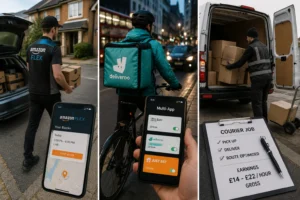
17. Amazon Flex
Block-based parcel delivery; 2–4 hour blocks.
Published rate: £13–£18/hour gross. After fuel, wear and insurance, realistic take-home: £10–£13/hour. Strong in suburban and semi-rural areas where traffic is lighter.
18. Deliveroo / Uber Eats / Just Eat (multi-apping)
Cycling or scooter in dense urban areas is most efficient.
Realistic: £8–£14/hour after costs in London; £6–£10 outside London. The rider community recommends working Friday–Sunday evenings and multi-apping across 2–3 platforms simultaneously.
19. Courier Van Work (courier aggregators like Hived, DPD Flex, Yodel)
Higher setup cost (van required) but better per-hour returns.
Realistic: £14–£22/hour gross for full days.
Passive and Asset-Based
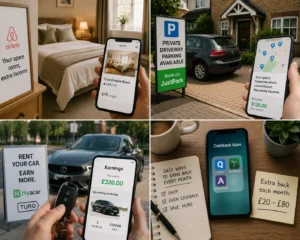
20. Renting a spare room on Airbnb
The Rent-a-Room scheme provides £7,500/year tax-free if you rent a furnished room in your own home. Above that, normal income tax applies. Realistic: £400–£1,200/month depending on location and room quality.
21. Renting your driveway
Via JustPark or YourParkingSpace. Realistic: £30–£200/month depending on location. Truly passive once set up. Airport and city-centre proximity are the key value drivers.
22. Renting your car
Via Hiyacar or Turo. Realistic: £150–£500/month. Requires comprehensive insurance that permits rental (specific add-ons available). Higher returns in areas with low car ownership.
23. Cashback apps (stacked)
Quidco, TopCashback, Airtime Rewards used simultaneously on normal spending. Not a hustle per se, but £20–£80/month in real money for doing nothing differently. Every side hustler should be doing this.
Content and Digital

24. YouTube
Realistic earnings: £0 for 6–12 months; then £200–£2,000/month at modest scale once monetised. UK CPM rates for personal finance and business content run £8–£20 per 1,000 views, significantly higher than general content. Most channels never reach monetisation threshold; treat this as a 2-year project if you pursue it.
25. Substack Newsletter
Realistic timeline: £0 for 4–8 months; then £50–£300/month at 100–300 paid subscribers at £5/month. Requires consistent publishing and a clear, specific niche. UK personal finance, local journalism, and B2B trade newsletters perform well.
26. AI Training Work (Outlier, Mindrift, Scale AI, Surge AI)
Marking, rating or rewriting AI model outputs.
Realistic: £15–£40/hour. Strong demand for UK-based subject experts in law, medicine, coding, and academic writing. Outlier publicly lists rates; Mindrift typically pays £20–£30/hour for UK-language tasks.
27. Selling Digital Products (Notion templates, Canva templates, digital planners)
Via Etsy or Gumroad.
Realistic: £0–£50/month for most sellers; breakout creators earn £500–£2,000+. Very saturated; success requires a genuinely useful, niche product and some marketing effort.
28. Voiceover Work
Via Voices.com, ACX (Amazon audiobooks), or direct outreach to local studios.
Realistic: £30–£150 per project once established. UK accents, especially RP, Scots, and regional Northern accents — are in consistent demand for corporate explainers and audiobooks.
29. Paid Surveys and Research Studies
Prolific is the gold standard for UK users: academic surveys, typically £6–£12/hour equivalent. Not a hustle but a genuine supplement. Most other survey sites pay too little to be worth the time.
30. Photography
Weekend bookings for events, portraits, or commercial work.
Realistic: £150–£600 per booking. Requires upfront equipment investment (£1,000–£3,000 for a starter kit) and 6–12 months of portfolio building before consistent bookings.
The £1,000 Trading Allowance — The Number That Changes Everything
This is the most important number in UK side hustle tax. Get it right and you may owe nothing. Get it wrong and you risk HMRC penalties, backdated tax, and interest.
The Rule
Every UK individual receives a £1,000 trading allowance per tax year (6 April to 5 April). If your gross side hustle income, the total amount paid to you before any expenses, platform fees, or deductions, stays below £1,000 in the tax year, you owe no tax and need not tell HMRC anything.
The Four Things That Catch People Out
First: it is gross income, not profit. HMRC measures what comes in, not what you keep. If you sold £1,200 of candles but spent £600 on wax, wicks and Etsy fees, your gross income is £1,200, not £600. You have crossed the threshold.
Second: it applies across all your side hustles combined. The £1,000 is a per-person allowance, not a per-activity allowance. If you earn £600 selling on Vinted and £500 doing paid surveys, your combined £1,100 has crossed the threshold, even though neither activity alone exceeded it.
Third: your personal allowance is a separate matter. The £1,000 trading allowance only determines whether you need to register and report. Whether you actually owe any tax depends on your total income including your salary. If your main job already uses your £12,570 personal allowance, every pound of side hustle profit above the £1,000 allowance will be taxed at your marginal rate, 20%, 40%, or 45%.
Fourth: Class 4 National Insurance applies too. Once your self-employed profits exceed £12,570, you pay Class 4 NIC at 6% on profits between £12,570 and £50,270, and 2% above that. Class 2 NICs were abolished for the majority of self-employed people from April 2024.
The Choice: Trading Allowance or Actual Expenses?
Once you cross the £1,000 threshold and file a Self Assessment return, you have a choice on how to calculate your taxable profit:
- Option A — Claim the £1,000 trading allowance as a flat deduction. No records needed. Taxable profit = gross income minus £1,000.
- Option B — Claim your actual allowable expenses. More admin required, but better if real expenses exceed £1,000.
You can only pick one per activity, and you cannot combine them. The rule of thumb: if your actual expenses (materials, platform fees, packaging, mileage) exceed £1,000, use Option B. If they do not, use Option A, it is simpler.
Worked Example
Scenario: You have a £32,000 salaried job. Your Etsy candle shop generated £3,800 gross in the 2025/26 tax year. Your actual materials and platform costs were £700.
Using trading allowance (Option A):
- Taxable profit: £3,800 minus £1,000 = £2,800
- Income tax at 20% basic rate (salary already uses personal allowance): £560
- Class 4 NIC at 6% (salary already exceeds £12,570): £168
- Total tax due on side hustle: £728
Using actual expenses (Option B):
- Taxable profit: £3,800 minus £700 = £3,100
- Income tax: £620
- Class 4 NIC: £186
- Total tax due: £806
In this case, the trading allowance (Option A) saves £78. Always run both calculations.
The £3,000 Threshold — Coming, but Not Yet
The government has signalled its intention to raise the reporting threshold from £1,000 to £3,000, which would mean earners between those amounts pay tax but do not need to file a full Self Assessment return.
However, as confirmed by multiple sources including ICAEW as of April 2026, this change has NOT been legislated. Until it is, the £1,000 gross threshold applies in full. Do not assume the higher threshold is already in force.
What HMRC Knows About Your Side Hustle? (Platform Reporting)
HMRC now receives automatic data from digital platforms, and significantly more than most people realise.
Since January 2025, UK law has required digital selling and service platforms to collect and report seller information to HMRC under the OECD DAC7 reporting rules. Platforms must report data for sellers who meet either of the following thresholds in a calendar year:
- 30 or more transactions, or
- More than approximately £1,700 in total sales (the precise threshold is €2,000, converted at the applicable rate)
The platforms currently reporting to HMRC include eBay, Vinted, Etsy, Depop, Airbnb, Uber, Deliveroo, Just Eat, Amazon, Fiverr and most other major digital marketplaces.
The majority of reports for 2025 activity arrived in January 2026. HMRC now has this data and is beginning to cross-reference it against Self Assessment returns.
What the Report Contains?
When a platform reports you, HMRC receives your name, address, National Insurance number, the platform’s name, and your total gross sales or service earnings for the year.
What This Means in Practice?
If you have been earning via platforms without declaring it and you exceeded either threshold, HMRC very likely has your data. The choice now is straightforward: register, declare, and pay any tax owed, or wait for an HMRC investigation letter, at which point the penalty calculations become significantly less favourable.
If you earn below both thresholds on each platform, you will not be reported through this route. But HMRC still has other methods of identifying undeclared income, including data from bank accounts, Companies House, and landlord registers.
Hmrc’s Help for Hustles Campaign
HMRC launched a dedicated “Help for Hustles” campaign in 2024 and continued it into 2025 and 2026. The gov.uk website includes a free, anonymous checker tool that asks a series of questions to help you identify whether your activity counts as trading and whether you need to register. If you are in any doubt, use it before reading further.
Making Tax Digital 2026 — Does It Affect Side Hustlers?
Making Tax Digital for Income Tax Self Assessment (MTD ITSA) is the most significant change to UK self-employment tax reporting in a generation. It came into force on 6 April 2026.

Who It Affects Right Now?
Phase 1 (from 6 April 2026): Sole traders and landlords with qualifying income, meaning gross income from self-employment and property combined of more than £50,000, based on the 2024/25 tax return.
If you are in scope, instead of a single annual Self Assessment return, you now submit quarterly digital updates to HMRC, plus a final annual declaration. HMRC estimates around 860,000 sole traders and landlords are affected in Phase 1.
Phase 2 (from April 2027): The threshold drops to £30,000.
Phase 3 (from April 2028): Expected to include those earning over £20,000.
Does This Affect Typical Side Hustlers?
For the majority of side hustlers earning under £50,000 from their hustle, MTD does not apply yet. You continue with the annual Self Assessment process.
However, there are two scenarios where it matters:
Scenario 1: If you have a full-time job earning £40,000 and a side hustle earning £12,000 gross, your combined qualifying income from self-employment is £12,000, which is below the threshold. MTD does not apply.
Scenario 2: If you have multiple income sources that combine above £50,000, for example, £35,000 in freelance income plus £20,000 in rental income, you are in Phase 1 scope from April 2026.
Note that a PAYE salary is not self-employment income and does not count toward the MTD qualifying income threshold. It is specifically gross income from self-employment and property.
What MTD Requires if You Are in Scope?
You must use HMRC-approved MTD-compatible software. As of 2026, compliant options include FreeAgent (free with NatWest/RBS business accounts), QuickBooks, Xero, Sage, and a growing list of smaller providers. You cannot file manually or via spreadsheet alone.
Quarterly update deadlines: 7 August, 7 November, 7 February, 7 May.
For most side hustlers reading this, MTD is something to be aware of for future planning, not an immediate obligation.
How to Register as Self-employed in the UK?
If your gross side hustle income exceeds £1,000 in a tax year, you must register for Self Assessment with HMRC.
The deadline to register is 5 October following the end of the tax year in which you crossed the threshold. For the 2025/26 tax year (6 April 2025 to 5 April 2026), the registration deadline is 5 October 2026.
How to Register? — Step by Step
- Step 1: Go to gov.uk/register-for-self-assessment. Select “I need to send a tax return for the first time.”
- Step 2: Tell HMRC you are self-employed (as a sole trader). Have your National Insurance number, contact details, and an estimate of your side hustle income ready.
- Step 3: HMRC will send you a Unique Taxpayer Reference (UTR) by post within 10 working days.
- Step 4: Use your UTR to create a Government Gateway account, or link it to your existing account if you have one.
- Step 5: File your Self Assessment tax return each year by 31 January (online) or 31 October (paper). The 31 January deadline also applies to paying any tax due.
Penalties for Missing the Registration Deadline
Missing the 5 October deadline triggers a potential “failure to notify” penalty. For careless non-disclosure, this can be up to 30% of the tax owed. For deliberate non-disclosure, up to 100%. If you register late but pay all tax owed before it is overdue, penalties are often significantly reduced, but do not rely on this.
If you have missed registration in previous years, the best action is to come forward voluntarily via HMRC’s voluntary disclosure service before they contact you. The penalties for voluntary disclosure are substantially lower than those imposed after HMRC initiates an investigation.
Side Hustle Tax — The Worked Examples
Three scenarios that represent the situations most UK side hustlers actually face.
Scenario A: Employed + Small Side Hustle Under the Allowance
Situation: £28,000 salaried job. Sold £800 of handmade cards on Etsy in 2025/26.
Result: Gross income is £800 — below the £1,000 trading allowance. No tax owed. No registration required. No Self Assessment. Keep records in case HMRC ever asks, but nothing else needed.
Scenario B: Employed + Side Hustle Just Over the Allowance
Situation: £35,000 salaried job. Completed £2,400 of freelance writing in 2025/26. No significant expenses.
- Gross income: £2,400
- Trading allowance deduction: £1,000
- Taxable profit: £1,400
- Income tax at 20% (personal allowance fully used by salary): £280
- Class 4 NIC at 6% (salary also above £12,570): £84
- Total tax bill: £364
- Net from the side hustle after tax: £2,036
Scenario C: Growing Side Hustle, No Other Employment
Situation: Left job in September 2025. Dog walking and pet sitting as only income from October 2025 to April 2026. Gross income for the 2025/26 tax year (6 months): £8,400. Allowable expenses (insurance, equipment, advertising): £1,100.
Using actual expenses:
- Taxable profit: £8,400 minus £1,100 = £7,300
- Personal allowance available (no salary): £12,570
- Since £7,300 is below the personal allowance: ZERO income tax
- Class 4 NIC: profit below £12,570 threshold — ZERO
- Total tax bill: £0
Note: even with no tax owed, registration and filing are still required because gross income exceeded £1,000. Failing to register is a separate offence from failing to pay tax.
Allowable Expenses — What You Can and Cannot Claim?
Once your gross income exceeds £1,000 and you opt for actual expenses rather than the trading allowance, keeping accurate records is essential. HMRC can request evidence up to 6 years after the tax year in question.
What You Can Claim?
Materials and stock: Anything you use to make your product or deliver your service. Candle wax, jewellery findings, coffee for a mobile barista, cleaning products for a cleaning business, ink and paper for a design service.
Platform and payment fees: Etsy listing fees, eBay final value fees, PayPal transaction fees, Stripe processing charges. These are often 10–15% of gross revenue and can add up to more than the £1,000 allowance if your turnover is significant.
Packaging and shipping: Boxes, tissue paper, postage labels, stamps, courier costs, when you are the one paying to ship the item.
Software and subscriptions: Any tool used wholly for the side hustle. Canva Pro if you use it only for the hustle, not for personal projects. Accounting software. Design tools. Email marketing platforms.
Mileage: If you drive for your side hustle (deliveries, visiting clients, transporting stock to markets), claim 45p per mile for the first 10,000 business miles in the tax year, and 25p per mile thereafter. Keep a mileage log, date, from, to, purpose, miles.
Home office (simplified): HMRC allows a flat rate without requiring detailed bills. £10/month if you work 25–50 hours from home on the hustle; £18/month for 51–100 hours; £26/month for over 100 hours.
Phone and internet: The business-use proportion only. If you use your phone 30% for the hustle and 70% personally, claim 30% of your monthly bill.
Marketing: Paid advertising, business cards, domain registration, hosting fees, local newspaper listings.
Professional fees: Accountant fees for preparing your tax return, legal advice specifically related to the business.
What You Cannot Claim?
Clothing you wear while working (unless it is a branded uniform or specialist safety equipment, a chef’s apron branded with your baking business name is fine; the jeans you wear while writing is not).
Meals and refreshments (even when working long hours on the hustle, there is no employee-style meal allowance for sole traders).
Fines and penalties (parking tickets while on a delivery, for example).
Gifts to clients above £50 per person per year.
The initial cost of a personal vehicle, even if used partly for the hustle (you claim the mileage rate instead, or a proportion of running costs if you use the actual costs method, but not both).
Keep Everything
Every receipt. Every invoice. Every bank statement. A photograph on your phone is acceptable if you store it systematically. Apps like Dext (formerly Receipt Bank) or even a labelled folder in Google Drive work well. The habit of recording at the point of purchase takes 30 seconds and saves hours of reconstruction at year-end.
Side Hustles by Profession
Different professions face different constraints and different opportunities. Here is what matters for the most commonly asking groups.
UK Teachers
Most teaching contracts permit side hustles in your own time, but check your school or trust’s policy before starting. Some contracts require disclosure of outside paid work; a small number restrict it for safeguarding reasons if it involves working with children independently.
Best matches: Private tutoring (obvious, but highest hourly rate available to teachers, up to £65/hour for A-level subjects), selling teaching resources on TES (passive; top UK TES sellers earn £2,000–£4,000/month), online course creation, examining for exam boards (supplement income while using skills you already have).
NHS Staff
NHS contracts vary significantly by Trust. Most do not prohibit side hustles, but standard provisions include: you cannot use NHS facilities, equipment, contacts or confidential information for personal commercial gain; you cannot work in a role that could create a conflict with your NHS duties; and locum work on top of your substantive post requires Trust approval.
Best matches: Medical writing, telehealth platforms (some now allow NHS staff to offer private consultations via third-party platforms), fitness coaching, wellbeing workshops, clinical template and protocol development, AI training for medical datasets (Outlier, Mendel, etc.).
UK Civil Servants
The Civil Service Management Code is explicit: civil servants must obtain prior written approval from their employer before engaging in outside work that could conflict with their official duties or bring the Civil Service into disrepute. “Conflict of interest” is interpreted broadly in some departments.
In practice, approval is routinely granted for activities clearly unrelated to your policy area, a Sunday dog-walking round, an Etsy craft shop, tutoring a school subject. Approval faces greater scrutiny for activities adjacent to your work area, consultancy roles, media work, or anything requiring use of government-adjacent expertise.
Apply for approval formally and in writing. Keep the approval letter. Do not start before it arrives.
Students — Under 18
Under-18s can earn money in the UK but there are restrictions on working hours during term time and total weekly hours. There is no specific prohibition on most side hustle activities — selling on Etsy, dog walking locally, tutoring younger students, online surveys — but some platforms have minimum age requirements (typically 18 for Vinted, Etsy, Airbnb; 16 for some others).
The £1,000 trading allowance applies from any age. Under-18s with taxable income file a Self Assessment return in exactly the same way as adults.
People on Universal Credit
This is the highest-stakes category. Declaring side hustle income correctly to the DWP is not optional, undeclared income that later surfaces can result in overpayment recovery (often via reduced future payments) and potential fraud referral in serious cases.
You must report all self-employment income monthly through your UC online journal. Your UC payment will be reduced at the standard taper rate: for every £1 you earn, your UC reduces by 55p (you keep 45p).
The Work Allowance (currently £379/month if you have children or a disability, or £631 if you are working and have no housing element) means you keep the first portion of earnings without any taper reduction.
The Minimum Income Floor (MIF) is a critical concept: once DWP recognises you as “gainfully self-employed” (usually after 12 months), it assumes you earn at least the National Minimum Wage equivalent for your expected hours.
This can reduce your UC even in months where your actual income is lower. The 12-month start-up period exempts you from the MIF, use it to build stable income before it kicks in.
Always speak to your work coach before starting. Most are more helpful than people expect.
How to Pick the Right Side Hustle for Your Life?
The right hustle is never the one with the highest theoretical ceiling. It is the one that fits your time pattern, income needs, energy levels, and tolerance for risk.

Run yourself through these four questions before starting:
Time Pattern: Do you have consistent evening hours (good for tutoring, VA work, writing), or unpredictable windows only at weekends (better for delivery, dog walking, events photography)? A hustle that demands hours you structurally do not have will fail regardless of its potential.
Income Predictability: Do you need the money to cover specific monthly expenses? Service income (cleaning, dog walking, tutoring) is more predictable. Product and content income is lumpier. Match the predictability of the hustle to the predictability you need from it.
Energy After Your Primary Work: Teaching all day and then tutoring burns identical cognitive and emotional reserves. Physical work followed by physical hustle is similarly draining. Where possible, pair contrasting activity types, cerebral job with physical hustle, or vice versa.
Interest Over 24 Months: Rankings and earnings data are irrelevant if you cannot stay consistent. Ask yourself: could I do this for two years, with limited results for the first six months? If the honest answer is no, pick something else.
Starting Capital: For the zero-cost hustles (writing, VA work, surveys, reselling what you already own), the only barrier is time. For trade-based hustles (dog walking, cleaning, handyman work), budget for public liability insurance and basic equipment (£100–£500 typically). For platform-based selling (Etsy, print-on-demand), budget for materials and initial product photography.
From First Pound to Full-time Income
Most side hustles that eventually become full-time businesses follow a recognisable arc. Understanding it stops you quitting at exactly the wrong moment.
Month 1–3: Zero to First Income
Expect almost nothing. Most platforms take weeks or months to generate organic visibility. Service-based hustles require local word-of-mouth that builds slowly. This is normal. The only goal in Month 1–3 is to earn your first pound and learn what that feels like. Do not benchmark against other people’s results at this stage, most who share results online are in the top 10%.
Month 3–6: First Consistent Income
Income starts becoming predictable. You have some repeat clients or reliable platform traffic. You are earning enough to confirm the model works. This is the point where most people either double down or quietly abandon the idea. The right move is to refine, not to scale. Identify what is working, do more of that specifically.
Month 6–12: Crossing the Trading Allowance
If you have been consistent, most service hustles cross £1,000 gross somewhere here. Register for Self Assessment as soon as you reasonably expect to cross it in the tax year, do not wait until you have crossed it. Open a dedicated bank account and start setting aside 25–30% of every payment for tax.
Month 12–24: Meaningful Income
You are earning £500–£2,000/month. It is covering a real portion of your expenses. This is the stage where people often consider quitting their job.
The correct threshold to consider this is higher than most people think: when your after-tax side hustle income reliably exceeds your job salary after tax, pension, sick pay entitlement, and any employee benefits you currently receive. That full comparison is almost never done by people who quit prematurely.
The Incorporation Decision
Once side hustle profits consistently exceed £30,000–£40,000/year, a conversation with an accountant about whether to incorporate as a limited company is warranted. The tax advantages (paying yourself via salary plus dividends) can be meaningful at that level. Below it, the additional administration and accounting costs of a limited company typically outweigh the savings.
The Most Common Side Hustle Mistakes
Over the course of this site, these are the patterns that come up again and again.
Mixing Money in One Account
Every side hustle pound that goes into your personal current account becomes a bookkeeping problem in January. Open a free second current account like Monzo, Starling, or Chase all offer these, and treat it as completely separate. All hustle income in; all hustle expenses out. Nothing else. This single habit saves more tax-return stress than any app or tool.
Forgetting the Trading Allowance is Gross
The number HMRC looks at is your total sales, not your profit, not your take-home after fees. This surprises people who assume “I only made £700 profit” means they are safe. If you grossed £1,400 and spent £700 on materials, you have crossed the threshold.
Not Setting Tax Aside as You Earn
The January shock is real. Every professional who has had a significant side hustle year and not set aside tax has experienced the horror of owing several hundred or several thousand pounds in one payment.
The fix: every time side hustle money arrives, immediately transfer 25–30% to a separate savings pot labelled “Tax.” Treat it as money that was never yours.
Underpricing at the Start
New service hustlers almost always start at half the local market rate because they do not feel confident enough to charge properly. This attracts the clients who cannot afford market rates, who are often the most demanding and least loyal. Price at market rates from day one. The right clients will still hire you.
Claiming Both the Trading Allowance and Actual Expenses
You cannot do both. HMRC will correct returns that attempt this and may flag the account for review. Choose one method per activity per tax year.
Scaling Before Stabilising
Spending on tools, courses, and software before the core income model works is premature optimisation. A £200 accounting tool subscription for a hustle earning £600/year is a hobby, not a business investment.
Frequently Asked Questions
Do I Need to Tell My Employer About My Side Hustle?
In most private-sector roles: no, unless your employment contract contains a specific clause requiring disclosure of outside work, or the hustle creates a conflict of interest with your employer’s business. HMRC does not notify employers. Check your contract before assuming either way.
What Happens if I Forget to Register and HMRC Finds Out?
If you come forward voluntarily before HMRC contacts you, penalties are significantly reduced, often to the level of interest on the unpaid tax alone. If HMRC opens a formal investigation first, “failure to notify” penalties can reach 100% of the tax owed for deliberate non-disclosure. The right action, if you have missed registrations, is voluntary disclosure via gov.uk.
Can I Run a Side Hustle on a Skilled Worker (Tier 2) Visa?
The rules depend on your specific visa conditions. Most Skilled Worker visas do not permit self-employment as a primary activity, but supplementary self-employment within your authorised occupation may be permitted. This is a complex area, seek advice from a regulated immigration adviser before starting.
How Long Do I Need to Keep Side Hustle Records?
HMRC requires records to be kept for five years from the 31 January filing deadline for the relevant tax year. For the 2025/26 return (filed by 31 January 2027), keep records until at least 31 January 2032.
What is the Difference Between a Side Hustle and a Second Job?
A second job means you are employed by a second employer. A side hustle means you are self-employed (sole trader). The key differences: a second employer deducts PAYE tax automatically; a side hustle requires you to register, track, and pay tax yourself.
Second jobs usually give you employment rights; self-employment generally does not. National Insurance differs between the two. In terms of tax liability, both count as income, your personal allowance covers your total income across all sources.
Will the £1,000 Trading Allowance Increase to £3,000 Soon?
The government has announced its intention to raise the Self Assessment registration threshold to £3,000, meaning earners between £1,000 and £3,000 would still owe tax but would use a simpler reporting route rather than a full Self Assessment return.
As of May 2026, this has not been legislated. The existing £1,000 threshold applies to the 2025/26 tax year and until the change is formally enacted.
Can I Side Hustle While on Sick Leave From Work?
It depends on the terms of your sick pay and your employment contract. If you are receiving statutory sick pay (SSP), the rules are less restrictive.
If you are receiving contractual sick pay, most contracts require you to be genuinely incapacitated from work and your employer may view an active side hustle as evidence you are not. Seek HR or legal advice before starting or continuing a side hustle while on sick leave.
Is There a Minimum Age to Start a Side Hustle in the UK?
No minimum age is set by law for self-employment. However, under-16s face working-hour restrictions, and most digital platforms require users to be at least 16 or 18. Under-18s with taxable income file Self Assessment returns like any adult, though in practice HMRC rarely pursues very small amounts.