
No, you do not automatically have to tell your employer about a side hustle in the UK. However, you may be contractually required to disclose outside work, obtain written permission, or declare a potential conflict of interest before starting.
This distinction matters because having a second income is generally legal, but breaching an employment contract or misusing an employer’s confidential information could put your main job at risk.
Whether you plan to start freelancing, provide private tutoring, sell products online, work evenings or establish a small business, the rules depend on your employment contract, professional obligations and the nature of your additional work.
For 2027, there are also two significant developments:
- 1 January 2027: The ordinary unfair-dismissal qualifying period falls from two years to six months in England, Scotland and Wales.
- 6 April 2027: The government plans to increase the trading allowance and related Self Assessment reporting threshold from £1,000 to £3,000, subject to the relevant legislation.
Our analysis of UK employment guidance, HMRC rules and business-owner considerations shows that the most important question is not how much your side hustle earns. It is whether it interferes with your existing employment obligations.
Do You Legally Have to Tell Your Employer About a Side Hustle in the UK?
There is no general UK law requiring every employee to inform their employer about an unrelated side business.
An individual can normally be employed and self-employed simultaneously. This means someone could work as an accountant during the day and operate an unrelated online shop during evenings or weekends.
However, your freedom to undertake additional work is not unlimited.
Five factors can create an obligation to inform your employer:
- Your employment contract requires notification or consent.
- Your employer’s applicable policies require disclosure.
- The activity creates an actual or potential conflict of interest.
- Your professional or regulatory responsibilities require declarations.
- The additional work raises legitimate concerns about working hours, performance or safety.
It is important to distinguish between notification and approval.
| Employment requirement | What it means | Practical action |
| No outside-work restriction | No specific contractual notification requirement | Check for conflicts and implied employment duties |
| Notification required | Employer must be informed | Disclose according to the policy |
| Prior approval required | Permission must be obtained before starting | Request written approval |
| Conflict-of-interest declaration | Relevant business interests must be disclosed | Complete the required declaration |
| Competitor restriction | Certain competing activities may be restricted | Obtain contract-specific advice |
| Regulated professional obligations | Additional reporting requirements may apply | Check the regulator and employer’s procedures |
For example, someone operating an independent dog-walking business outside their office hours presents a different risk from an employee secretly offering competing consulting services to their employer’s customers.
Our assessment is that the relationship between the two businesses matters substantially more than the label side hustle.
UK employees can also operate as sole traders while remaining employed. The business and salary arrangements are explained in more detail in being employed and self-employed at the same time.
Which Employment Contract Clauses Could Restrict Your Side Hustle?
Before launching a business, review your employment contract, staff handbook, conflict-of-interest policy and any relevant amendments.
We identified five contractual areas that deserve particular attention.
1. Secondary Employment and Outside Business Activities
Some contracts require employees to inform management before accepting another job or operating a business.
An illustrative clause might say:
“Employees must obtain written permission before undertaking other paid employment or business activities.”
This is example wording, not a quotation from a particular employer.
Where a valid consent clause applies, simply informing HR may not satisfy the requirement.
An important distinction is whether the contract covers additional employment, self-employment, or both.
For instance, taking a second PAYE job and operating an independent consultancy are different arrangements, as explained in our comparison of a side hustle versus a second job.
2. Exclusivity Clauses
An exclusivity clause attempts to restrict an employee from working elsewhere, sometimes without prior permission.
Such clauses are not always enforceable.
UK employment law provides particular protections for workers on zero-hours contracts and certain low-income workers.
Employees should therefore avoid assuming that every restriction printed in an employment contract is automatically valid.
3. Conflict-of-Interest Clauses
A conflict arises when your personal financial interests could interfere with your responsibility to your employer.
Consider an employee at a digital marketing agency who begins providing similar services privately.
If the private clients are completely unrelated businesses, the conflict may be manageable.
However, targeting existing agency customers or using confidential campaign information raises substantially greater risks.
An employee may also have an implied duty of fidelity, which generally prevents them from improperly competing with their employer or misusing confidential information.
4. Confidentiality and Intellectual Property
Employees should not assume they can use company resources for a private business merely because the work takes place outside office hours.
Potential problems include:
- Using a company laptop to operate a personal business.
- Copying employer-owned customer databases.
- Reusing proprietary software or business processes.
- Approaching confidential client contacts.
- Uploading confidential employer information into personal AI tools.
- Developing business products using materials that belong to the employer.
Ownership of intellectual property depends on the law, contractual terms and circumstances in which the work was created.
Using personal equipment and keeping activities separate reduces risk, but it does not automatically resolve every ownership question.
5. Working Hours and Performance
A contract may require employees to avoid other activities that materially affect their ability to perform their jobs.
For example, a delivery driver working extensive overnight hours elsewhere could create fatigue and road-safety concerns.
The employer’s concerns may be legitimate even if the second activity does not compete with its business.
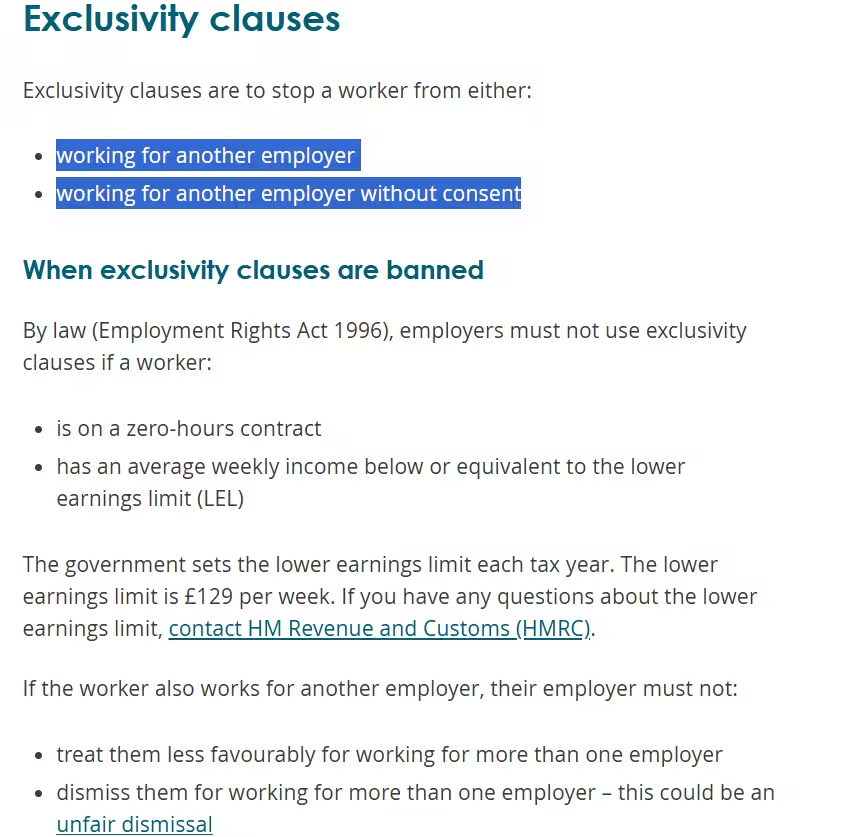
Acas explains the circumstances in which exclusivity clauses may be prohibited and how contractual restrictions can affect additional employment.
Can Your Employer Stop You From Having a Side Hustle?
An employer cannot automatically control every lawful activity you undertake in your personal time.
However, an employer may have legitimate grounds to restrict an outside business where a valid contractual obligation, conflict of interest, confidentiality issue or safety risk exists.
An unrestricted second income is not an absolute statutory right for every employee.
Our review separates employer objections into three practical categories.
| Employer objection | Assessment |
| Side hustle directly competes with the business | Potentially legitimate |
| Side hustle uses company information | Strong grounds for concern |
| Employee breaches a valid approval requirement | Potential contractual breach |
| Additional work creates a safety risk | Potentially legitimate |
| Side hustle damages performance | May justify management action |
| Employee earns more than their salary elsewhere | Not automatically legitimate |
| Employee operates an unrelated business outside work | Usually a weaker basis for objection |
| Employer dislikes entrepreneurship generally | Not, by itself, a complete legal justification |
The wording of the contract and the surrounding facts remain important.
Special Protection for Zero-Hours and Low-Paid Workers
Under the Employment Rights Act 1996, exclusivity clauses are prohibited for workers on zero-hours contracts and qualifying workers whose average weekly income is at or below the National Insurance Lower Earnings Limit.
For 2026/27, that lower earnings limit is £129 per week. The government has published a figure of £133 per week for 2027/28.
These protections relate to restrictions on working for another employer. They should not be interpreted as blanket permission to operate a competing business, misuse confidential information or ignore other lawful obligations.
Which Side Hustles Are Most Likely to Require Employer Disclosure?
Not every income-generating activity presents the same employment risk.
We developed the following editorial assessment to illustrate which situations deserve closer scrutiny.
How our percentage ratings work: These are illustrative disclosure-priority scores, not measured probabilities of dismissal or survey findings.
We assess five factors: contractual restrictions (30%), commercial conflict (25%), confidentiality exposure (20%), working-hours risk (15%) and regulatory or reputational exposure (10%).
Higher scores suggest a stronger practical reason to review and disclose the activity. A score never overrides an actual legal or contractual requirement.
| Side hustle scenario | Disclosure-priority rating | Our assessment |
| Office administrator selling handmade crafts | 15% | Lower concern if unrelated and unrestricted |
| Retail employee doing weekend dog walking | 20% | Usually easier to separate from employment |
| Employee operating an unrelated tutoring service | 25% | Check outside-work requirements |
| Office worker taking another PAYE job | 45% | Working hours and contract matter |
| Marketing employee doing freelance marketing for unrelated clients | 65% | Greater need to examine competition and client overlap |
| NHS clinician providing private clinical services | 85% | Professional, patient-safety and employer-policy concerns |
| Employee approaching employer’s customers for a competing business | 95% | Significant commercial and confidentiality risk |
These scores are editorial illustrations, not legal classifications.
A low-scoring activity may still require prior written consent under a valid contract.
For someone seeking flexible work with clear separation from an employer, private tutoring and certain virtual assistant services can be practical options, provided the clients, working hours and information used do not create conflicts.
What Employment Law Changes in 2027 Affect Employees With Side Hustles?
The Employment Rights Act 2025 introduces important changes to the unfair-dismissal framework from 1 January 2027.
The ordinary qualifying period for unfair-dismissal protection in Great Britain is reducing from two years of continuous employment to six months.
This is relevant to employees operating side businesses because workplace disputes sometimes arise when an employer believes an employee has broken an outside-work restriction.
What Changes Between 2026 and 2027?
| Employment protection | 2026 position | From 1 January 2027 |
| Ordinary unfair-dismissal qualifying period | Usually 2 years | 6 months |
| Some automatically unfair dismissal claims | No qualifying period in relevant cases | Remains protected |
| Compensation cap for ordinary unfair dismissal | Statutory cap applies | Cap removed |
| Contractual obligations | Still apply | Still apply |
| Valid conflict-of-interest restrictions | Still relevant | Still relevant |
These ordinary unfair-dismissal qualifying-period changes apply in England, Scotland and Wales.
Northern Ireland has a separate employment-law framework, and the ordinary qualifying period there is generally one year.
The changes do not mean an employee can disregard a valid contract or automatically win a claim when disciplined for operating a side business.
For example, an employee with eight months’ service whose employment ends in February 2027 may generally qualify to bring an ordinary unfair-dismissal claim in Great Britain.
Whether that claim succeeds depends on the reason for dismissal, the employer’s conduct and the evidence.
Employers can still potentially dismiss employees fairly for serious misconduct or legitimate contractual breaches.
Our business assessment is that the shorter qualifying period increases the importance of clear outside-work policies, documented decisions and proportionate disciplinary procedures.
What Should Employees Do?
Retain copies of relevant contract terms, emails requesting permission and written employer decisions.
What Should Employers Do?
Clearly distinguish ordinary personal activities from genuine competitive or safety concerns.
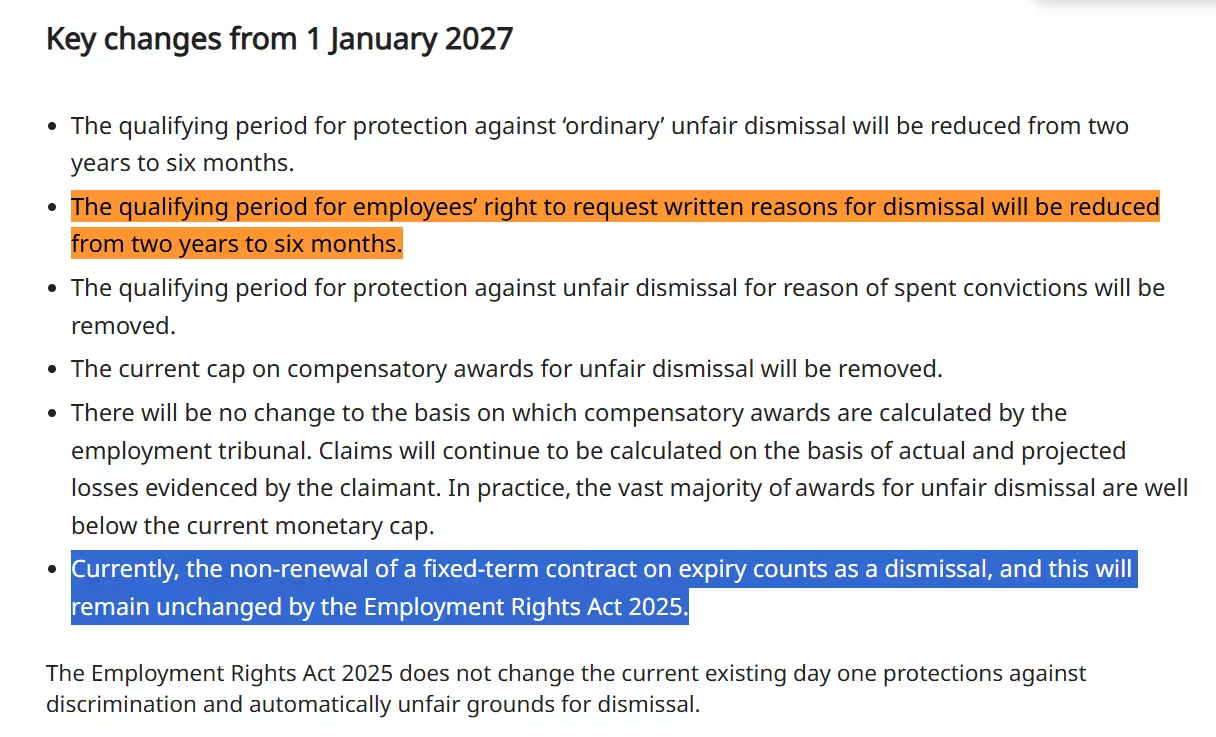
GOV.UK confirms the reduction in the ordinary unfair-dismissal qualifying period from two years to six months from 1 January 2027.
How Should You Tell Your Employer About a Side Hustle?
Where disclosure is required or advisable, a clear written explanation is generally more useful than an informal conversation alone.
Our recommended procedure has six steps.
Step 1: Check Your Employment Documents.
Search your contract and staff policies for:
- Secondary employment
- Outside business activities
- Exclusivity
- Conflict of interest
- Confidentiality
- Intellectual property
- Prior written consent
Step 2: Describe the Side Hustle Accurately.
Identify the activity, its customers, expected working hours and whether the business operates in the same sector as your employer.
Step 3: Evaluate Conflicts.
Consider whether you will serve your employer’s customers, use employment-related information or have personal interests that might influence your decisions at work.
Step 4: Check Whether Notification or Approval Is Required.
If your contract requires approval, submit the request before beginning the activity.
If you are unsure about the scope or enforceability of a clause, seek appropriate employment-law advice rather than ignoring it.
Step 5: Explain How You Will Protect Your Main Job.
Confirm that you intend to keep the activity separate from working hours, company resources and confidential information.
Step 6: Retain the Written Response.
Keep any permission, conditions or acknowledgement alongside your employment documents.
If your business changes significantly, such as by entering the employer’s market or taking on major new clients, reassess the approval.
Example Email to Inform Your Employer
Subject: Notification of Outside Business Activity
Dear [Manager/HR Team],
I would like to inform you that I am planning to undertake a small self-employed activity outside my normal working hours.
The activity involves [brief description of the side hustle] and is expected to take approximately [number] hours per week.
I intend to keep this work separate from my employment responsibilities. I will not use company equipment, confidential information, client relationships or working time for the activity.
Based on my current understanding, the business will not directly compete with the company or affect my performance in my existing role.
Please let me know whether any formal declaration or written approval is required under company policy. If approval is necessary, I would appreciate confirmation before I begin.
Kind regards,
[Your Name]
This wording should be adapted to the actual activity rather than used to make assurances that have not been checked.
If the business creates a possible conflict, describe it openly and ask how it can be managed.
Will HMRC Tell Your Employer That You Have a Side Hustle?
HMRC does not routinely notify a person’s employer merely because they register for Self Assessment or report self-employed income.
Your employer generally handles the tax administration relating to your employment salary, while you remain responsible for reporting eligible self-employed income.
However, this does not mean your additional activity is guaranteed to remain unknown.
There are several routes through which an employer could become aware of your business.
| Discovery route | Could employer find out? | Explanation |
| Registering for Self Assessment | Not routinely | HMRC does not ordinarily send registration notices to employers |
| PAYE tax-code change | Possibly | Employer receives revised code, not a full explanation of the reason |
| Companies House registration | Yes | Certain company and director details are publicly searchable |
| LinkedIn or professional website | Yes | Public business activity may be visible |
| Social media promotion | Yes | Marketing can reveal the business |
| Existing company clients | Yes | Shared customers may disclose the relationship |
| Employer’s conflict declaration | Yes | Information is provided directly |
| Second PAYE employment | Possibly | Payroll and tax administration may change, but employer notification is not automatic |
The tax-code distinction is especially important.
An employer’s payroll department receives the PAYE tax code required to calculate tax deductions. It generally does not receive the employee’s detailed Self Assessment tax return through that process.
A revised code could reflect several circumstances, including other income, benefits or tax adjustments.
Therefore, a code change is not proof that someone has a side hustle.
Employees should not rely on tax privacy as a way to avoid an employment obligation.
For the tax reporting process, see how to declare side hustle income to HMRC.
How Much Side Hustle Income Can You Earn Before Telling HMRC in 2027?
One of the biggest developments for UK side businesses is the government’s October 2026 announcement that the trading allowance will increase from £1,000 to £3,000 from 6 April 2027.
The associated Self Assessment reporting threshold for trading income is also due to rise to £3,000.
The changes are intended to be introduced through Finance Bill 2026–27, so the legislation should be checked before treating the higher allowance as enacted.
The essential point is that this is an HMRC tax change, not a change to an employee’s obligation to tell their employer.
Trading Allowance Comparison
| Tax rule | 2026/27 | Planned 2027/28 |
| Trading allowance | £1,000 | £3,000 |
| Related trading-income reporting threshold | £1,000 | £3,000 |
| Increase in allowance | — | 200% |
| Allowance available per month? | No | No |
| Allowance generally assessed across relevant trading income? | Yes | Yes |
| Employer disclosure automatically required above threshold? | No | No |
The planned increase represents a 200% rise in the allowance.
It does not mean that every person earning less than £3,000 can ignore all tax obligations. Eligibility restrictions and other reasons for submitting a tax return may still apply.
For example, the trading allowance generally cannot be claimed against income from an existing employer or certain connected businesses.
Employees should also distinguish trading activity from simply selling unwanted personal belongings.
The relevant 2026 rules are explained in our trading allowance breakdown.
Worked Example: A Full-Time Employee With a Freelance Business
Consider an employee earning a £36,000 annual salary who also provides freelance design services.
Assume:
- Annual employment salary: £36,000
- Annual freelance turnover: £4,200
- Actual allowable business expenses: £600
- Trading allowance is available and more beneficial than claiming actual expenses
- The employee is a basic-rate taxpayer in England, Wales or Northern Ireland
| Calculation | 2026/27 | Planned 2027/28 |
| Freelance turnover | £4,200 | £4,200 |
| Trading allowance deducted | £1,000 | £3,000 |
| Taxable trading profit | £3,200 | £1,200 |
| Illustrative Income Tax at 20% | £640 | £240 |
| Potential annual saving | — | £400 |
The employee could potentially save £400 in Income Tax under the planned change, assuming eligibility and unchanged circumstances.
These are illustrative figures, not a personal tax calculation.
The example also demonstrates that a side hustle may create a tax obligation without automatically creating an employer-notification obligation.
For further examples, see side hustle tax alongside a PAYE job.
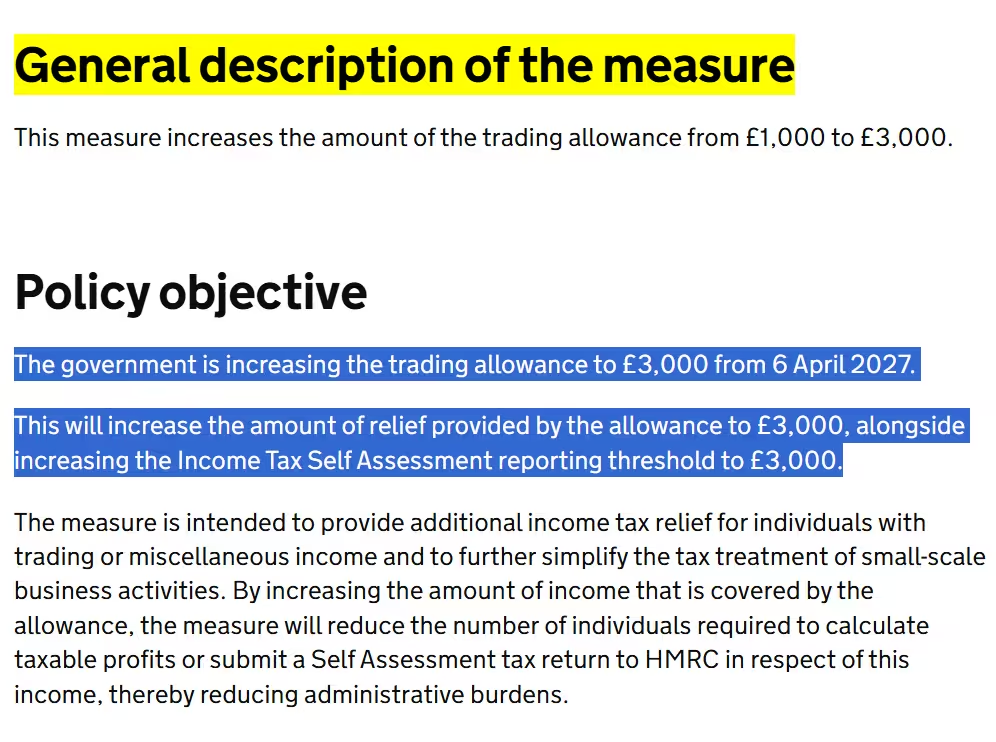
HMRC’s October 2026 announcement confirms the planned increase in the trading allowance from £1,000 to £3,000 for the 2027/28 tax year.
What Other Tax and Business Requirements Should Employees Consider?
Employer approval and HMRC compliance are separate matters.
Someone may have their employer’s permission to operate a business but still fail to meet tax registration or reporting requirements.
Conversely, registering correctly with HMRC does not override an employment contract.
Our analysis identifies five additional responsibilities worth considering.
Self Assessment Deadlines
For relevant sole-trader income earned during 2026/27, the normal registration deadline is 5 October 2027, with online filing and payment generally due by 31 January 2028.
For 2027/28, where registration and filing are required, the corresponding dates will generally be 5 October 2028 and 31 January 2029.
These dates may differ where HMRC has already issued a notice to file or specific circumstances apply.
Detailed deadlines are covered in self-employed registration deadlines.
National Insurance
For 2026/27, Class 4 National Insurance generally becomes payable when self-employed profits exceed £12,570, subject to the relevant rules and combined-employment adjustments.
Earning £40,000 in PAYE salary does not, by itself, mean that the first pound of a small self-employed profit automatically attracts Class 4 contributions.
The self-employed National Insurance rates provide further detail.
Business Expenses
Self-employed workers should compare the trading allowance with the option to deduct actual allowable expenses.
Both methods cannot generally be used against the same trading income.
The side hustle expenses guide covers common costs such as business software, equipment and other qualifying expenditure.
Making Tax Digital
From April 2027, Making Tax Digital for Income Tax extends to qualifying sole traders and landlords whose relevant gross income exceeded £30,000 in the 2025/26 tax year.
This generally considers qualifying self-employment and property income rather than simply adding a PAYE salary to side-business turnover.
Business Administration
Someone operating a substantial or growing business may need to consider business insurance, appropriate registrations, contractual liability, banking arrangements and potentially VAT registration.
For basic setup, registering as self-employed explains the steps involved.
Does the 48-Hour Working Week Apply When You Have a Side Hustle?
The Working Time Regulations 1998 normally limit a worker’s average working time to 48 hours per week, usually calculated across a 17-week reference period.
Where someone holds two employed jobs, their combined working time is relevant.
For example:
| Employment arrangement | Weekly hours |
| Primary employment | 40 |
| Second employed job | 12 |
| Combined weekly hours | 52 |
| Difference from 48-hour average | 4 hours above |
Working more than 48 hours is not automatically unlawful in every case.
Eligible adult workers may voluntarily sign a valid written opt-out agreement, and certain roles are subject to exceptions or different rules.
The rules are more nuanced where someone combines employed work with genuinely self-employed business activity. Not all independent self-employed working hours are automatically covered in the same way as hours worked under employment or worker contracts.
Nevertheless, excessive hours can still create genuine health, safety and performance concerns.
Our recommendation is to record working hours and consider their effect on your main responsibilities.
For example, someone working a 37.5-hour office week and completing six hours of freelance work would have 43.5 hours of combined activity.
That arrangement may be easier to manage than undertaking another 25 hours every week.
In physically demanding roles, fatigue is particularly important.
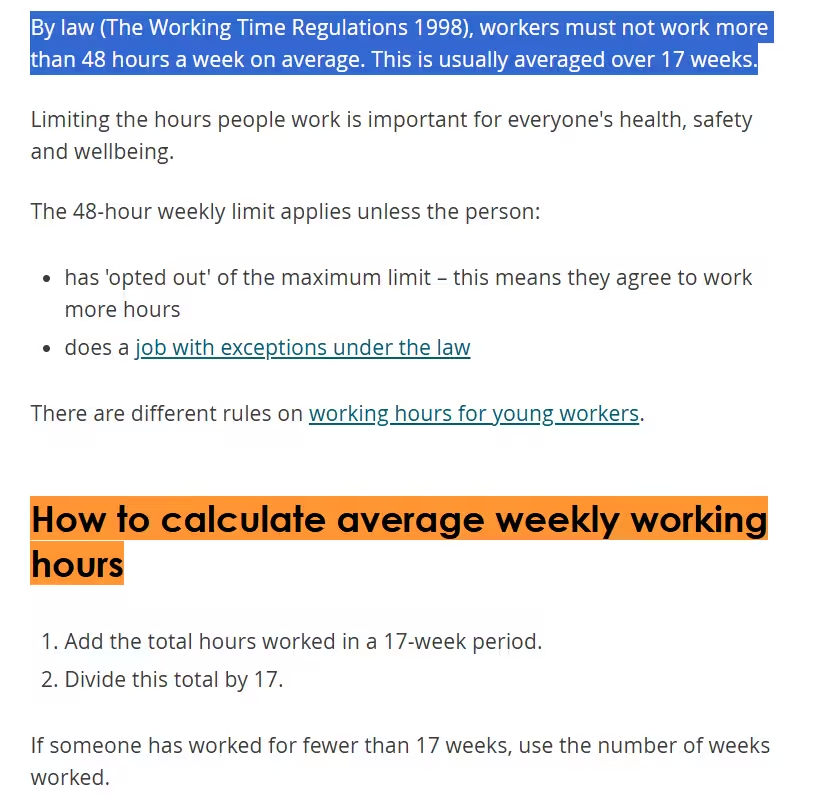
Acas explains the 48-hour average working-week limit, calculation period and voluntary opt-out arrangements.
Do NHS Staff, Teachers, Civil Servants and Finance Workers Have Different Rules?
Yes. Certain occupations have additional contractual, professional or public-interest requirements.
These can make disclosure necessary even where a similar side hustle would present relatively little risk in an ordinary private-sector office role.
| Profession | Main concern | Recommended action |
| NHS employees | Patient safety, confidentiality, secondary employment | Check NHS employer policy and professional obligations |
| Teachers | Safeguarding, pupils, tutoring conflicts | Review school or trust policy |
| Civil servants | Impartiality, conflicts and outside interests | Follow departmental declaration and approval procedures |
| Financial-services staff | Regulatory conduct, client interests and conflicts | Check compliance requirements |
| Solicitors and regulated professionals | Professional conduct, confidentiality and conflicts | Review regulator and employer rules |
| Skilled Worker visa holders | Immigration conditions and permitted supplementary work | Check visa conditions before starting |
NHS Employees
NHS organisations can have different secondary-employment policies.
Clinical work outside NHS employment may raise specific concerns about indemnity, fatigue, professional conduct and patient confidentiality.
Our NHS nurses’ side hustle guide examines these employment considerations in more detail.
Teachers
Private tutoring may be permitted, but tutoring current pupils, using school materials and accessing pupil information can create problems.
Teachers should consult their employer’s specific policy rather than assume that tutoring is unrestricted.
See side hustles for teachers.
Civil Servants
Civil Service guidance expects remunerated outside employment, work and appointments to be declared.
Where an outside activity might affect Civil Service work directly or indirectly, appropriate approval should be sought.
Individual departments may have additional procedures.
Our detailed review of side hustles for civil servants covers these requirements.
Financial-Services Professionals
Employees in regulated firms may be subject to policies covering outside business interests, conflicts, directorships and other appointments.
The applicable rules depend on the firm’s regulatory obligations and the individual’s role. It would be inaccurate to assume that every employee in financial services is subject to an identical external-employment declaration requirement.
Visa Holders
Employment permission does not necessarily mean unrestricted permission to become self-employed.
For migrants whose right to work depends on a visa, immigration restrictions may be more important than the ordinary employer-disclosure question.
Those circumstances are covered in side hustles for UK visa holders.
Can You Be Dismissed for Not Telling Your Employer About a Side Hustle?
Potentially, yes.
A dismissal may arise where an employee has broken a valid disclosure requirement, competed improperly with their employer, misused information or committed other misconduct.
However, there is no automatic rule that failing to mention every outside activity justifies dismissal.
The circumstances matter.
Consider three illustrative situations.
Scenario 1: An Unrelated Side Business
An employee works in financial administration and sells handmade home accessories on weekends.
Their contract has no relevant restriction, and the activity does not affect their employment.
An employer would generally have a weaker basis for taking disciplinary action solely because the employee operates that business.
Scenario 2: Failure to Obtain Required Permission
An employee’s contract requires written approval for outside paid work, but they begin a substantial consultancy without seeking consent.
Even if the business does not directly compete, the employer may have grounds to investigate a contractual breach.
The seriousness of any action depends on the clause, the employee’s conduct and the employer’s response.
Scenario 3: Secretly Competing for Customers
A senior sales employee begins approaching the same clients for an independent competing business using confidential pricing information.
This creates a much more serious risk of disciplinary action, dismissal and potentially civil proceedings.
Our assessment is that the third scenario is fundamentally different from an ordinary employee earning supplementary income from an unrelated activity.
What If the Employer Refuses Permission?
Ask for the reason in writing. Check whether the refusal is consistent with the contract and any statutory protections.
If the refusal appears unreasonable or discriminatory, consider an internal grievance, trade union advice or advice from Acas or an employment solicitor.
Do not assume that a contractual restriction becomes unenforceable simply because the employee disagrees with it.
What Should Business Owners Consider When Employees Run Side Businesses?
Side hustles create operational questions for employers as well as employees.
From a business-management perspective, a consistent policy is preferable to making arbitrary decisions about individual employees.
A useful policy should clarify:
- Which activities require disclosure.
- When prior consent is necessary.
- How conflicts are assessed.
- Whether employees may serve customers in the same industry.
- What company resources must not be used.
- How fatigue and working hours are managed.
- When previously granted permission should be reviewed.
A small business owner employing a graphic designer, for instance, may reasonably want to protect customer relationships and confidential project information.
That does not necessarily justify prohibiting the employee from undertaking every unrelated personal business activity.
Our analysis suggests the strongest approach is to establish transparent boundaries before problems arise.
For employees, the financial decision should be equally commercial.
Before starting a side hustle, calculate whether it is worthwhile after taxes, expenses and the value of the time committed.
For instance, an individual generating £500 in monthly revenue might not retain £500 in additional disposable income.
Software subscriptions, travel, platform charges, insurance and Income Tax may reduce the amount considerably.
A side business that grows beyond supplementary earnings may eventually become a full-time venture. Our analysis of scaling a side hustle to full-time income explores the business considerations involved.
What Is Our Final Assessment of Telling an Employer About a Side Hustle?
We evaluated the decision using contractual compliance, financial benefit, business conflicts and practical working arrangements.
The following ratings are editorial priority assessments, not survey results, predicted legal outcomes or independently measured performance statistics.
| Recommended action | Editorial priority |
| Review employment contract before starting | 100% |
| Protect employer confidential information | 100% |
| Seek written consent where contractually required | 100% |
| Assess conflicts of interest | 95% |
| Review working hours and fatigue | 90% |
| Keep appropriate HMRC records | 95% |
| Obtain written acknowledgement when voluntarily disclosing | 85% |
| Keep employer and private-business equipment separate | 95% |
The most important finding is that having a side hustle does not necessarily undermine an employment relationship.
A carefully managed side business can give employees another income source while enabling them to test an idea without immediately abandoning a salary.
However, a successful side hustle should not depend on concealing an activity that the employee is legally or contractually required to disclose.
People who are still comparing business models can explore the complete UK side hustles guide for additional options.
Conclusion
You do not automatically have to tell your employer about a side hustle in the UK in 2027. The deciding factors are your employment contract, applicable workplace policies, conflicts of interest and any additional professional obligations.
Our analysis shows that running an independent business alongside employment is a legitimate option for many workers. The legal and commercial risks increase when outside work overlaps with employer interests, uses confidential resources or affects performance.
The changes taking effect in 2027 make it particularly important to distinguish employment rights from business-tax obligations.
Review your contract before starting, obtain written permission where required, keep your income records accurate and establish clear boundaries between your employment and your business.
This article reflects published UK guidance and announced reforms as reviewed in November 2026. Future tax measures remain subject to their legislative status. It provides general information, not individual legal, tax or financial advice.
Frequently Asked Questions
Do I Have to Tell My Employer About a Side Hustle if I Earn Less Than £1,000?
Not automatically. The £1,000 figure is relevant to the trading allowance for the 2026/27 tax year, not employer disclosure.
Your employment contract and any professional obligations determine whether the side activity must be declared.
Do I Need My Employer’s Permission to Become Self-Employed?
There is no universal requirement for every UK employee to obtain employer permission before becoming self-employed.
However, a valid employment contract or applicable professional policy may require notification or approval.
Can My Employer Find Out About My Side Hustle Through HMRC?
HMRC does not routinely tell employers about Self Assessment registration.
Employers may receive revised PAYE tax codes but generally not the detailed reasons or the employee’s full self-employment tax return.
The activity may become known through other routes, including publicly available business information.
Can I Have Two Jobs Without Telling My Employer?
Sometimes, provided there is no applicable notification requirement, enforceable restriction or conflict.
Employees should also check combined working hours and whether statutory exclusivity protections apply.
Can My Employer Sack Me for Having a Side Hustle in 2027?
Dismissal is possible where legitimate reasons exist, such as misconduct or breach of contract.
From 1 January 2027, the ordinary unfair-dismissal qualifying period reduces to six months in Great Britain. That protection does not make every dismissal related to a side hustle automatically unfair.
Does the £3,000 Trading Allowance Mean I Can Keep My Side Hustle Secret?
No. The government’s planned increase from 6 April 2027 concerns taxation and reporting to HMRC.
It does not change an employer’s contractual right to require appropriate disclosure.
Should I Tell My Employer About a Side Hustle Even When My Contract Does Not Require It?
Voluntary disclosure can be sensible where the activity overlaps with your employment, could develop into a competing business, or might create future questions about working hours or conflicts.
For a clearly unrelated, low-risk activity, there may be no need to disclose it. The decision should be based on the actual circumstances, not a blanket rule.

More in Tax, Legal & HMRC

Can I Be a Sole Trader and Employed at the Same Time in the UK?
Yes, a person can be employed and operate as a sole trader at the same time in the UK. Someone could work full-time or part-time for an employer while also running a freelance business, consultancy, online store, trade or other side business. HMRC specifically confirms that a person can be employed and self-employed simultaneously. For […]

Do I Need a Business Account as a Sole Trader in the UK?
A sole trader does not legally need a separate business bank account in the UK. Because a sole trader and their business are treated as the same legal person, business income can technically be received into a personal current account. However, the bank’s account terms still matter. Some personal current accounts prohibit or restrict business […]