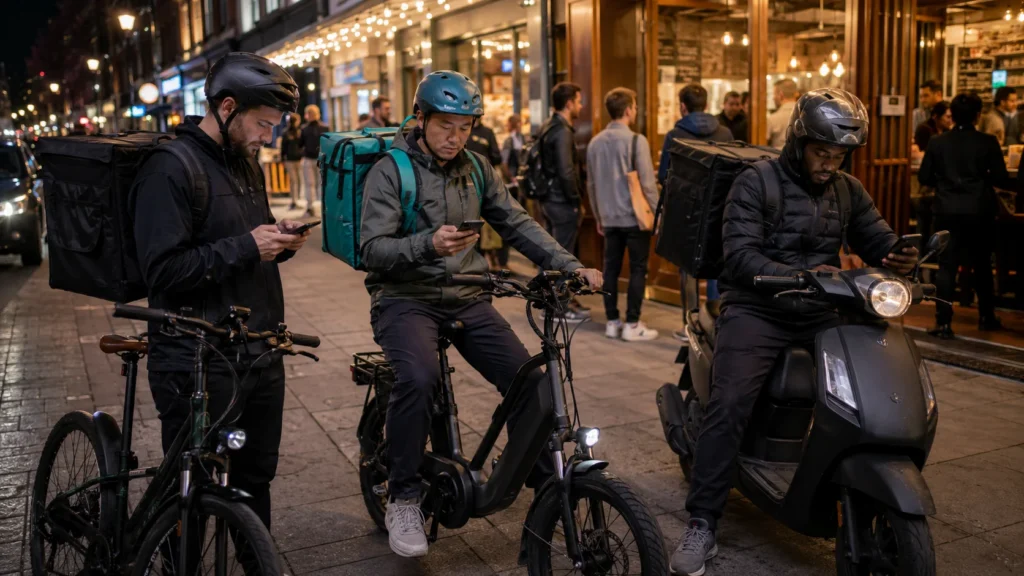
Three platforms, one side hustle, very different real-world earnings depending on which you use, where you live, what vehicle you ride, and what time of day you work. The internet is full of Deliveroo vs Uber Eats vs Just Eat comparisons that quote headline rates. This one quotes after-cost rates.
According to NimbleFins’ 2026 research of the UK market, food delivery drivers earn between £9–£15 per hour on average before expenses.
After fuel, insurance, and vehicle costs, the realistic take-home for most riders is closer to £8–£12/hour, and significantly less if you are using a car in a city where cycling or an e-bike would be faster.
The headline number you need to understand is this: Uber Eats’ median take-home in 2026 is £9–£11/hour after expenses, with the top 10% of riders clearing £14–£17/hour by timing their shifts strategically and multi-apping. Those top earners are not earning more per delivery; they are earning more because they have zero dead time between deliveries.
This guide breaks down the platform differences, the actual after-cost numbers for each, the vehicle equation, the multi-apping strategy that separates moderate earners from consistent earners, and what changed in 2024 that every rider needs to know.
For a full overview of UK side hustle options beyond delivery, see our complete guide to UK side hustles.
What Changed in 2024 — the Just Eat Shift
If you researched delivery platforms a few years ago, you would have seen Just Eat’s employed “Scoober” model, a scheme that guaranteed minimum hourly wages, sick pay, and holiday pay. Just Eat scrapped this model in the UK completely in early 2024.
Today, Just Eat couriers operate as independent contractors paid per delivery, exactly like Deliveroo and Uber Eats. There is no guaranteed hourly wage. You earn based on the volume of deliveries you complete. The employment rights that Scoober offered no longer exist.
This matters because comparison articles written before 2024 frame Just Eat as the “safer” option with guaranteed pay. That framing is out of date.
All three platforms now pay per delivery, all three classify riders as self-employed, and all three come with the same fundamental uncertainty: you earn nothing when no orders come in.
The Deliveroo Employment Status Note
In November 2023, the UK Supreme Court confirmed that Deliveroo riders are not “workers” in the legal sense, they are self-employed contractors.
This ruling, which followed a long legal battle by the IWGB union, means Deliveroo riders are not entitled to the National Living Wage, holiday pay, sick pay, or pension contributions. The same self-employed status applies across all three platforms.
How Each Platform Pays?
1. Deliveroo
Deliveroo pays per delivery. The fee per order is calculated based on distance, order value, current demand, and zone. Deliveroo does not publicly publish its fee structure, but rider community reports consistently indicate per-delivery fees of £3–£7 for standard orders, with higher fees for longer distances and during surge demand.
Deliveroo deducts a service fee from delivery earnings using a variable percentage. On average, riders report Deliveroo retaining roughly 20–30% of delivery fares, though this varies significantly by order. Tips received through the app go entirely to the rider; the platform does not take a cut of tips.
2. Uber Eats
Uber Eats also pays per delivery using a variable per-trip fee based on distance, time, and demand. Uber deducts a service fee from every delivery fare.
The fee is not a flat percentage; higher-value, longer-distance deliveries tend to attract a lower percentage, while short, low-value orders can see a much larger slice taken. On average, most drivers report Uber retaining roughly 20–30% of their delivery fares.
Uber Eats generally offers higher per-delivery fees than Deliveroo or Just Eat, but the commission structure means gross fees are not the same as take-home. Uber Eats tips are kept entirely by the rider.
3. Just Eat
Just Eat pays per delivery with fees that, according to rider community forums and Indeed salary data in 2026, typically yield £10–£14/hour during standard shifts, with higher earnings possible during peak dinner rushes. The fee structure is broadly similar to the other two platforms.
One operational difference: Just Eat’s app and order assignment algorithm tend to offer shorter-distance orders than Deliveroo or Uber Eats in many areas. This can mean more deliveries per hour but at lower fees per delivery. The net effect varies significantly by city.
Real Earnings Comparison (2026)
These figures are sourced from NimbleFins’ 2026 UK market research, SimplyQuote’s March 2026 earnings guide, and rider community reports. They represent a realistic experience for an average rider in a mid-size UK city.
Gross Hourly Earnings (Before Vehicle Costs)
| Platform | City Cycling | E-bike | Moped/Scooter | Car |
|---|---|---|---|---|
| Deliveroo | £9–£13/hr | £10–£14/hr | £11–£15/hr | £10–£14/hr |
| Uber Eats | £10–£14/hr | £11–£15/hr | £12–£16/hr | £11–£14/hr |
| Just Eat | £9–£13/hr | £10–£13/hr | £11–£14/hr | £10–£13/hr |
Net Hourly Earnings (After Typical Vehicle Costs)
These deductions are approximate and will vary by vehicle age, fuel price, and insurance type:
- City cyclist: deduct £0.50–£1/hr for bike maintenance
- E-bike rider: deduct £1–£2/hr for electricity and maintenance
- Moped/scooter: deduct £2–£4/hr for fuel and insurance
- Car: deduct £4–£7/hr for fuel, insurance, and depreciation
Net Reality for Most Riders
Most riders on a bicycle or e-bike in a dense city area net £8–£12/hour realistically. Moped and car riders often net significantly less once fuel and insurance are factored in, particularly for car delivery outside London, where order volume does not justify the running costs.
The honest figure used consistently by UK rider support communities: expect £8–£11/hour net if you are cycling in a UK city, and do not expect this to increase significantly without moving to an e-bike or applying the multi-apping strategy.
The Vehicle Equation
The vehicle you use determines your ceiling more than which platform you choose.
1. Bicycle (City-only)
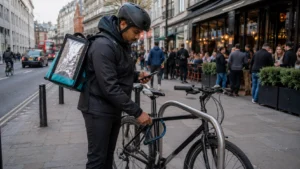
Lowest cost, best for dense city centres. No fuel, minimal insurance, low maintenance. Works best within a 1–2 mile delivery radius. In central London, Manchester, Bristol, and Leeds city centres, a cyclist can complete 3–5 deliveries per hour during peak times. In suburbs or smaller towns, order frequency drops sharply and cycling becomes impractical.
2. E-bike

The best vehicle for UK delivery work in most scenarios. Higher speed than a pedal bike across a wider radius without the fuel cost of a moped. E-bike running costs: approximately £0.02–£0.04/mile in electricity. No licence required. Insurance optional but advisable.
The upfront cost (£400–£1,500 for a quality delivery e-bike) is the barrier, but amortised over a year of regular use, the hourly advantage over a pedal bike typically justifies it within 3–4 months.
3. Moped / Scooter
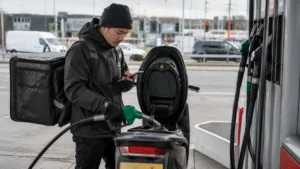
Effective for suburban and semi-rural areas where cycling is not viable. Requires at least a CBT certificate and appropriate hire-and-reward insurance.
Fuel costs significantly reduce net earnings. Zego and other pay-as-you-go insurers offer flexible rider insurance specifically for gig delivery work essential because standard personal motor insurance does not cover delivery.
4. Car
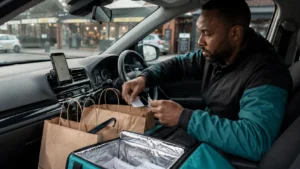
The least efficient option for delivery work in most UK scenarios. Higher running costs, parking challenges, and slower average speed in city centres make the car economics difficult to justify for most riders.
The exception: high-value orders for premium restaurants and late-night delivery in suburban areas where the distance per order is higher.
The Multi-apping Strategy
The most consistent earnings pattern in the UK delivery community is multi-apping: running two or three delivery apps simultaneously so that downtime between orders on one platform is filled by orders from another.
The logic: each platform’s order volume fluctuates. A period of no orders on Deliveroo often coincides with available orders on Uber Eats. By staying active on both, a rider eliminates most dead time during a shift.
In practice: keep both apps open, set yourself as available on both, and accept the first order that comes in. When delivering for one platform, set yourself as temporarily unavailable on the others to avoid accepting an order you cannot fulfil.
Compliance: all three platforms technically permit multi-apping in their terms of service, none explicitly prohibit working for competitors simultaneously. However, this can change, and the risk is that accepting and cancelling orders (if you accept from two platforms at once accidentally) results in account flags.
The earnings difference: riders who multi-app consistently report earning 20–35% more per hour compared to single-platform working during the same shifts, purely by reducing dead time. For a rider earning £9/hour on a single platform, multi-apping typically lifts that to £11–£12/hour net.
The Best Shifts: When and Where to Ride
Time matters more than platform choice for maximising earnings.
PEAK HOURS (highest order volume and fastest delivery fees)
- Lunch: 11:30am–2pm (Thursday–Sunday highest)
- Dinner: 6pm–9:30pm (Friday and Saturday highest)
- Late night: 10pm–midnight in city centres (Friday and Saturday only)
Dead Hours to Avoid
- Monday–Thursday mornings and afternoons outside of lunch
- Sunday mornings before 11am
- Bank holiday Mondays (reduced restaurant opening, lower demand)
Location Matters More Than Most Guides Acknowledge
In London, Manchester, Bristol, Leeds, Edinburgh, and Birmingham city centres, where restaurant density is high and order-to-rider ratios are favourable, earnings are consistently at the higher end of the range.
In suburban areas and smaller towns, order frequency drops significantly. Riders in low-density areas consistently report net earnings below £8/hour even during peak times.
The practical rule: if you can easily reach a high-density restaurant zone within 10 minutes of where you start your shift, the economics work. If you need to travel 20+ minutes to the nearest cluster of restaurants, the travel time eats into your earnings significantly.
The True Cost of Delivery Work
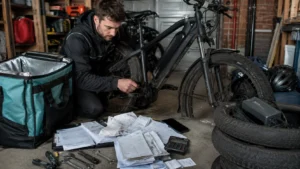
Beyond the obvious fuel and insurance costs, several less-visible costs reduce take-home for delivery riders.
Vehicle Maintenance
Regular cleaning, chain maintenance (bikes), tyre replacement, battery servicing (e-bikes), and oil changes and MOT costs (mopeds and cars). On a bicycle, budget £150–£250/year. On an e-bike, £200–£400/year. On a moped, £400–£800/year.
Hire-and-reward Insurance
Standard vehicle insurance does not cover delivery work. You need hire-and-reward (H&R) cover. For cyclists, public liability insurance is advisable, though not always required by platforms.
For moped and car riders, H&R insurance is mandatory. Zego, ZEGO, and Veygo offer pay-as-you-go H&R cover priced by the hour, useful for part-time riders. Annual H&R insurance for a moped in 2026 starts at approximately £400–£800, depending on experience and location.
Phone Costs
A reliable smartphone and data plan are essential for delivery work. If you are burning through battery and data on delivery shifts, factor this into your costs. A basic data top-up and a USB handlebar mount (£10–£15) are the minimum viable setup.
Thermal Bag
Required by all three platforms. Supplied free on sign-up by Deliveroo, Uber Eats, and Just Eat may require purchase (£10–£30 from Amazon or platform stores).
Tax Rules for UK Delivery Riders

As self-employed contractors, delivery riders are responsible for their own tax and National Insurance. There is no PAYE deduction from delivery earnings.
The £1,000 Trading Allowance
If your gross delivery earnings (before any costs) stay below £1,000 in a tax year, no tax is owed, and no registration is required. Most riders who do a handful of shifts per month will cross this quickly, even at £9/hour net; 12 hours of delivery work puts you over the threshold.
Registering for Self-assessment
Once gross earnings across all self-employed activities exceed £1,000 in a tax year, register for Self Assessment by 5 October following that year. Your gross delivery income goes on the SA103 self-employment pages.
Allowable Expenses
Delivery riders can claim the actual running costs of their vehicle as allowable expenses: fuel, oil, insurance, repairs, maintenance, and a proportion of the vehicle’s purchase cost (capital allowances).
Alternatively, use HMRC’s simplified mileage rate: 20p/mile for motorcycles, 25p/mile for cars and vans (after the first 10,000 miles, dropping to the standard rate). Cyclist expenses can include maintenance and equipment.
Setting Aside Tax
Transfer 25–30% of every delivery payment into a separate savings account immediately. At £9/hour net for 10 hours/week, that is roughly £90/week in earnings, meaning approximately £22–£27 per week should be set aside for tax. After 12 months of full-time delivery work, the tax bill can be a significant shock if not planned for.
Frequently Asked Questions
Which platform pays the most per hour in the UK in 2026?
Uber Eats generally offers slightly higher per-delivery fees than Deliveroo or Just Eat in most UK cities. However, the difference is smaller than most comparisons suggest, and the actual take-home depends far more on location, vehicle, shift timing, and whether you multi-app than on which single platform you use.
Do I need a special licence to deliver on a bicycle?
No. Cycling delivery requires no licence. You need a roadworthy bike and ideally public liability insurance. For mopeds and motorcycles, a CBT certificate is the minimum (full motorcycle licence for larger bikes). Cars require a standard driving licence and hire-and-reward insurance.
Is Just Eat still the safest option with guaranteed pay?
No. Just Eat scrapped its employed Scoober model in early 2024. All three platforms now pay per delivery with no guaranteed minimum hourly wage. There is no platform that guarantees earnings for self-employed delivery riders in the UK in 2026.
Can I do Deliveroo and Uber Eats at the same time?
Yes, multi-apping is legal and compliant with the terms of service of all three platforms. The practical risk is accidentally accepting orders from two platforms simultaneously, which can result in cancellations and account warnings. Use the available/unavailable toggle on each app actively to avoid this.
What is the minimum I need to start delivering?
A bicycle or vehicle that meets road safety requirements, appropriate insurance, a smartphone, and a thermal bag. The Deliveroo sign-up provides a thermal bag at no cost. For Uber Eats and Just Eat, you may need to purchase one. Sign-up takes 1–3 days on average for verification and onboarding.
What to Read Next?
If delivery work does not match your schedule or vehicle situation, see our comparison of what Vinted sellers earn if you prefer selling to driving.
For a full comparison of hourly rates across all side hustle types, see our guide on how delivery compares to other top-paying side hustles.

More in Platforms & Apps

Etsy UK First Sale Guide: Setup to Sale (2026 Beginner Walkthrough)
Most Etsy guides tell you how to open a shop. This one tells you how to get your first sale, which is a different question. The honest timeline: most new Etsy sellers with no existing audience wait two weeks to three months for their first sale. Sellers who approach the platform systematically with clear photography, […]

Airbnb UK Spare Room Side Hustle: 2026 Earnings & Tax Guide
Renting a spare room on Airbnb is the side hustle with the most generous tax treatment in the UK. Under the Rent-a-Room scheme, you can earn up to £7,500 per year from renting a furnished room in your main home completely tax-free. No Self Assessment required, no receipts to keep, no tax to pay on […]