
Nursing in the UK involves irregular shift patterns, physical and emotional demands, and NHS employment contracts that come with specific rules about outside work.
The side hustle that works for a teacher or a civil servant does not necessarily work for a nurse. What you need are options that fit around 12-hour shifts, that do not require you to be cognitively “on” after a ward round, and that do not create conflicts with your NMC registration or your Trust’s secondary employment policy.
This guide covers the best flexible side hustles for UK NHS nurses in 2026 options that are compatible with NHS employment rules, preserve your professional registration, and generate real income without burning out someone who is already doing one of the most demanding jobs in the country.
If you want a broader view of what UK side hustles are available, our complete guide to UK side hustles covers every category.
What NHS Employment Rules Say About Side Hustles?

The NHS does not operate under a single national employment contract for all staff contract terms vary between Trusts, CCGs, and individual employment agreements. However, most NHS employment contracts for nursing staff include a secondary employment clause.
These clauses typically fall into one of two categories. The first requires you to notify HR of any outside paid work before starting. The second requires you to seek and receive prior written approval.
These are different obligations. Notification means you inform your employer; approval means you must wait for a positive response before proceeding.
The key concern behind these clauses is not whether you earn money elsewhere. The concern is whether additional work:
- Creates a conflict of interest with your NHS role
- Uses NHS confidential patient data, resources, or clinical contacts commercially
- Compromises your ability to perform your NHS duties safely (fatigue being the primary risk)
- Could bring reputational damage to your Trust
In practice, secondary employment applications for work that is clearly unrelated to your NHS role dog walking, selling on Vinted, writing, creative work are almost always approved quickly. Applications for clinical work outside the NHS face more scrutiny around patient safety and conflict of interest.
The practical step before starting: locate your contract and find the secondary employment clause. If it requires notification, send a brief email to HR. If it requires approval, submit a formal request before you start. Keep the approval in writing. This protects you if the situation is ever queried.
One additional note: working excessive combined hours creates a direct patient safety risk in nursing. The Working Time Regulations 1998 set a general 48-hour average limit across all employment.
For safety-critical roles like clinical nursing, the expectation from your Trust, the NMC, and common sense is that you do not take on outside work that leaves you fatigued at the bedside.
This is not a bureaucratic concern. It is a real risk. Any side hustle that consistently eats into sleep or rest between shifts should be reconsidered regardless of the income.
NMC Registration: What Changes When You Earn Outside the NHS?
Your NMC registration is personal it does not belong to your employer. Earning income outside the NHS does not automatically affect it. However, a few specific situations require attention.
If you are providing any form of clinical care or health advice in a paid capacity outside the NHS, such as health coaching, private wound care, wellbeing consultations, telehealth nursing you are acting as a nurse in a commercial capacity.
The NMC Code applies in full. This means you must maintain fitness to practise, document appropriately, maintain CPD, and critically hold appropriate professional indemnity insurance.
Most NHS employers provide indemnity cover only for NHS work. For clinical work outside the NHS, you need personal professional indemnity insurance.
The Royal College of Nursing (RCN) provides member indemnity cover for certain categories of private nursing work check your membership level and the scope of cover before offering any clinical service privately.
For non-clinical side hustles writing, AI training work, tutoring, creative work, selling products your NMC registration is irrelevant. You are simply an individual earning additional income. No special NMC consideration applies.
The 8 Best Side Hustles for NHS Nurses
1. Medical Writing and Health Content

Earnings: £18–£45/hour | Time: fully flexible, evenings | Startup cost: £0
NHS nurses have a significant advantage in the health content market: credibility.
Digital health publishers, patient information charities, telehealth platforms, and pharmaceutical companies regularly commission nurses and other registered clinicians to write patient-facing health content, clinical summaries, and educational materials.
Platforms to find work: Contently (build a portfolio), Clearvoice, LinkedIn outreach to health publishers, and direct approaches to organisations such as Healthline UK, Patient.info, and NHS charity communications teams.
Rates vary by brief: straightforward patient education articles pay £15–£25 per piece; specialist clinical content reviewed against NICE guidelines commands £35–£50 per 1,000 words.
RCN members with documented specialisms often find nursing publications (Nursing Standard, Nursing Times) will commission at £200–£400 per feature-length article.
The non-clinical point: writing about health topics does not make you a practising clinician in the NMC sense. You are acting as a subject-matter expert and author. Standard NMC competence requirements apply to the accuracy of information you publish, but professional indemnity insurance is not required for health writing.
2. AI Training Work for Medical Datasets
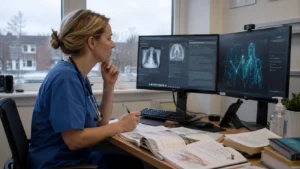
Earnings: £22–£40/hour | Time: fully flexible | Startup cost: £0
Platforms including Outlier, Mindrift, Scale AI, and Mendel regularly advertise for registered nurses and other clinical professionals to evaluate, write, and fact-check medical and health content for AI training purposes.
Work involves tasks such as assessing whether an AI-generated clinical explanation is accurate, writing example patient scenarios, and identifying factual errors in health information.
Pay rates for medical subject matter experts are typically at the higher end of these platforms’ scales £22–£40/hour equivalent in the UK. The work is entirely remote, has no fixed schedule, and requires no clinical interaction.
The NMC consideration: this is non-clinical knowledge work. No patient contact, no prescribing, no clinical decisions. The NMC Code does not apply in the way it would to clinical practice. However, the professional obligation of accuracy is still relevant you should not knowingly validate incorrect medical information.
3. Health and Wellness Coaching

Earnings: £30–£80/hour | Time: flexible | Startup cost: £100–£300 (platform/marketing)
Nurses are well-positioned to offer health coaching nutrition guidance, lifestyle modification support, chronic condition self-management coaching, and stress and wellbeing programmes outside of direct clinical care.
The regulatory position: health coaching is not a regulated activity under the Health and Care Professions Council (HCPC) or NMC in the same way that clinical nursing is.
However, if you are operating as a nurse and offering health-related guidance commercially, you are acting in a professional capacity and should hold professional indemnity insurance. The RCN’s indemnity cover may apply check directly with them for your specific situation.
The most common entry route: wellbeing workshops for corporate clients and gyms, or one-to-one coaching via platforms such as Practice Better or Healthie. Initial clients typically come through LinkedIn, local fitness communities, or nurse-run social networks.
4. Telehealth Nurse Roles (Private Sector)

Earnings: £18–£28/hour | Time: flexible sessions | Startup cost: £0 (clinical cover required)
Several UK telehealth platforms Babylon, Livi, Doctorlink, and sector-specific occupational health providers hire registered nurses for remote triage and health advice services.
These are employment or zero-hours contracts rather than true side hustles, but they offer genuine schedule flexibility and fit well around shift work.
The critical requirement: these roles involve clinical practice. Professional indemnity insurance provided by the telehealth company must cover your activities. Confirm this explicitly before accepting any work. Additionally, inform your NHS employer as required by your secondary employment clause.
5. Tutoring Nursing Students and Healthcare Trainees

Earnings: £25–£55/hour | Time: flexible | Startup cost: £0
The demand for mentoring support among nursing students particularly those on placement or preparing for OSCEs and written exams has grown consistently as nursing programmes have expanded.
Private nursing tutors are not common in the same way that GCSE tutors are, which means demand is underserved relative to supply.
Positioning: advertise specifically as a registered nurse with clinical experience offering exam preparation for nursing degree students. Platforms: Tutorful and Superprof both support this category; direct promotion on university nursing society pages and nursing student Facebook groups converts well.
This is non-clinical tutoring. You are teaching knowledge and exam technique, not providing clinical care. Professional indemnity insurance is not required. A DBS check may be requested by some adult learners’ educational institutions.
6. Selling Health and Wellness Products

Earnings: variable £50–£500+/month | Time: upfront setup + minimal ongoing | Startup cost: £100–£500
Nurses who create evidence-based, clearly signposted health information products printed patient guides, revision resources for nursing students, wellbeing planners, medication tracking diaries can sell these via Etsy, Amazon, or a personal website.
The important boundary: products must be clearly positioned as general health information, not clinical advice. Statements like “This guide helps you track your medications” are fine. Statements that imply clinical diagnosis or treatment recommendations cross into regulated territory.
Printable products (PDF downloads) have zero per-unit cost and scale without inventory. A nursing student revision guide sold at £6–£12 on Etsy can generate consistent passive income once listed and promoted.
7. Occupational Health Consulting

Earnings: £200–£500 per day | Time: occasional days | Startup cost: £50–£150 (insurance, materials)
Registered nurses with occupational health experience or qualifications can consult independently for small businesses who need workplace health risk assessments, return-to-work support, or absence management guidance.
The market: small businesses with 10–50 employees often cannot justify a full-time occupational health service but need periodic input. One engagement per month at £250 adds £3,000/year. NHS occupational health experience is directly transferable.
Regulatory requirements: clinical professional indemnity insurance is required. An appropriate nursing qualification and NMC registration are prerequisites.
Most independent occupational health consultants register with Cogent Health or similar accreditation bodies to establish credibility with corporate clients.
8. Reselling and Product Side Hustles

Earnings: £80–£400/month | Time: flexible | Startup cost: £0–£100
For nurses who want side income that is completely separate from their professional identity and requires no clinical thinking, reselling on Vinted or Etsy, cashback app stacking, or completing paid surveys (Prolific) are all viable options.
These require no secondary employment approval in most cases (a non-clinical, unrelated activity typically does not need to be declared), no professional registration consideration, and no additional insurance.
The trade-off is lower hourly value compared to clinical knowledge work, but the psychological separation from nursing work has genuine recovery value for someone in a high-stress clinical role.
Side Hustles to Avoid as an NHS Nurse
Clinical Work That Could Compromise Patient Safety
Avoid taking on clinical roles outside the NHS that leave you short of rest between NHS shifts. The Working Time Regulations and your NMC duty of candour obligations both apply here. Fatigue-related clinical errors do not disappear because the shift causing the fatigue was private.
Using NHS Contacts or Patient Data Commercially
Referring NHS patients to private services you own or benefit from, or using patient data for any commercial purpose, is a serious breach of NHS employment terms and potentially a criminal offence under the Data Protection Act 2018. This includes subtle referral arrangements, not just overt data theft.
Competing Clinical Services in Your Trust’s Catchment
Setting up a private nursing service that directly competes with your NHS Trust’s services, in the same geographic area, serving the same patient population, creates conflict of interest issues that most secondary employment clauses specifically prohibit.
Earnings Overview
| Side Hustle | Rate | Monthly Potential | Clinical? | NHS Approval Needed? |
|---|---|---|---|---|
| Medical Writing | £18–£45/hr | £200–£600 | No | Rarely |
| AI Training Work | £22–£40/hr | £200–£500 | No | Rarely |
| Health Coaching | £30–£80/hr | £300–£800 | Borderline | Usually Yes |
| Telehealth Nursing | £18–£28/hr | £400–£900 | Yes | Always |
| Nursing Tutoring | £25–£55/hr | £150–£400 | No | Rarely |
| Wellness Products | Variable | £50–£400 | No | No |
| Occupational Health | £200–£500/day | Variable | Yes | Always |
| Reselling / Surveys | Variable | £80–£300 | No | No |
Tax Rules That Apply to Nurse Side Hustle Income
Your NHS salary is taxed through PAYE. Your side hustle income is your own responsibility. The rules are the same as for any other UK earner.
If your gross side hustle income across all activities exceeds £1,000 in a tax year (6 April to 5 April), you must register for Self Assessment by 5 October following that year and file a tax return by 31 January.
For most NHS nurses, the salary will already have used the £12,570 personal allowance, so side hustle profit above the £1,000 trading allowance is taxed at 20% basic rate. Higher earners (total income over £50,270) will pay 40%.
The practical rule: immediately transfer 25–30% of every side hustle payment into a separate savings account. Treat it as money already committed to HMRC.
For a full breakdown of how side income interacts with your employment income and how side income affects NHS pension and benefits, see the relevant guides linked throughout this article.
Frequently Asked Questions
Does the NMC know I am doing a side hustle?
Only if your side hustle involves clinical practice that comes to the NMC’s attention through a fitness to practise concern, a complaint, or a mandatory referral. Earning income through non-clinical side hustles writing, AI work, selling products, has no connection to the NMC.
Will my side hustle income affect my NHS pension?
Your NHS pension contributions and benefits are based on your NHS earnings only. Non-NHS income does not affect your NHS pension calculation. However, the total pension you draw in retirement may be relevant to your overall tax position a question for a qualified financial adviser.
Can I use my NMC registration as a selling point for my side hustle?
Yes, in the sense of describing yourself as a registered nurse to establish credibility for non-clinical professional work (writing, coaching, tutoring). No, in the sense of implying your NMC registration endorses or validates a commercial health product or service in a misleading way. The NMC is clear that using your registration to lend commercial weight to services it does not regulate would be misrepresenting the nature of NMC registration.
What if my Trust refuses my secondary employment application?
Trusts can refuse secondary employment requests where they have reasonable grounds related to patient safety, conflict of interest, or contractual obligations. If you believe the refusal is unreasonable, you can raise a grievance or seek advice from the RCN. For non-clinical side hustles that clearly do not affect your NHS duties, refusals are uncommon most decisions are made by ward managers or HR teams who will approve unrelated work readily.
Is tutoring nursing students clinical practice?
No. Teaching knowledge, exam technique, and academic skills to nursing students is educational work. It does not constitute nursing practice in the NMC sense. However, if you are providing direct clinical supervision in a paid capacity outside your NHS role, that is clinical practice and the NMC Code applies.
What to Read Next?
UK teachers also face similar contract and professional obligations. If you work in a school healthcare setting or are interested in comparing notes on professional side hustle rules, see our article on side hustles for UK teachers facing similar restrictions.
If you also have questions about whether your earnings could affect benefit entitlements or NHS occupational sick pay, our guide on how side income affects NHS pension and benefits covers the interactions in detail.

More in By Profession

Side Hustles for UK University Students (Earn £200–£800/month)
According to Save the Student’s 2025 National Student Money Survey, 30% of UK students are now working a side hustle alongside their studies. Research from herestudents.com published in January 2026, based on a survey of several hundred UK undergraduates and postgraduates, found the average monthly side hustle income among students who have one to be […]

Legal Side Hustles for UK Students Under 18 (2026 Earnings Guide)
Earning money before you turn 18 in the UK is completely legal, but the rules are different from those that apply to adults, and several popular earning platforms have minimum age requirements that catch young people out. This guide covers exactly what UK students under 18 can legally do to earn money in 2026: the […]